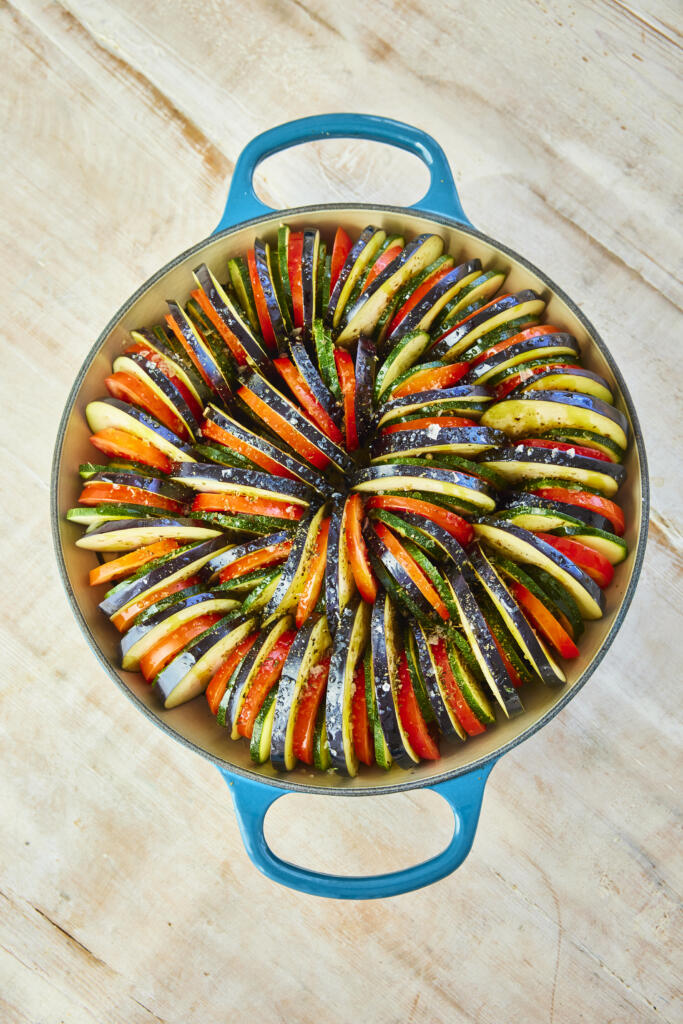
This oven‑baked ratatouille layers thin slices of aubergine, courgette and tomato in neat concentric circles for maximum flavour and a beautiful finish. Seasoned with Maldon Original Sea Salt, oregano and olive oil, the vegetables bake until tender with lightly caramelised edges. It’s an easy ratatouille recipe that celebrates peak‑summer produce, delicious warm or at room temperature and perfect as a vegetarian side or light main with crusty bread.
How to Make Oven-Baked Ratatouille?
Slice aubergine, courgette and tomato to 3 mm; season with Maldon Sea Salt.
Arrange in concentric circles; add oregano and olive oil.
Bake at 180°C fan for 30 minutes until tender and caramelised; finish with basil.
How to Make Oven-Baked Ratatouille (Detailed Version)
Step 1 – Heat the Oven & Slice Evenly
Preheat oven to 180°C fan (200°C conventional / 400°F).
Thinly slice aubergines, courgettes and tomatoes to pound‑coin thickness (~3 mm) using a mandolin or sharp knife for even cooking. Make sure you pat the wet tomatoes slices dry before arranging to avoid pooling which can cause the dish to become soggy!
Sprinkle the slices with Maldon Original Sea Salt to season and draw out a little moisture.
Step 2 – Arrange the Vegetables
In a round baking dish, lay slices in concentric circles, alternating aubergine, courgette and tomato.
Sprinkle over dried oregano and drizzle generously with olive oil.
Step 3 – Bake to Tender & Caramelise
Bake for about 30 minutes until the top is lightly caramelised and vegetables are tender when pierced. The edges of the dish should be lightly browned, centres soft but holding their shape.
Rest 5 minutes; scatter basil leaves and finish with a final pinch of Maldon.
Tips & FAQs
Tips
Even thickness is key: 3 mm slices cook at the same rate and layer neatly.
Season in layers: a light pre‑salt plus a finishing sprinkle of Maldon brightens flavours.
For extra colour, switch to grill/broiler for 1–2 minutes at the end.
If your dish is deep, cover loosely with foil for the first 15 minutes, then uncover to caramelise.
FAQs
What’s the difference between this and classic stewed ratatouille?
This is a sliced, baked version (often called confit byaldi style) with neat layers; classic ratatouille is a chopped, stovetop stew.
Can I add peppers or onions?
Yes—very thinly sliced red pepper or onion can be tucked between layers without changing timing much.
Do I need to salt and drain the aubergine?
Not essential with thin slices and modern aubergines; a light pre‑salt is sufficient.
How thick should I slice the vegetables?
About 3 mm (pound‑coin thickness). Thicker slices may need 5–10 extra minutes.
Can I make ratatouille ahead?
Bake, cool and refrigerate up to 2 days. Reheat covered at 170°C (340°F) for 12–15 minutes or enjoy at room temperature.
Serving Suggestions
Serve as a side with roast chicken, grilled fish, steak or lamb.
Make it a main: add torn mozzarella or crumbled goat’s cheese after baking; serve with crusty bread, couscous or soft polenta.
Finish with a drizzle of good olive oil, extra basil, or a splash of balsamic.
Storage & Reheating
Refrigerate leftovers in an airtight container for up to 3 days.
Reheat at 170°C (340°F) until hot (10–15 minutes) or enjoy room‑temperature.
Not ideal for freezing (tomatoes can become watery), but can be frozen for up to 1 month if needed; reheat from thawed and finish under the grill to re‑caramelise.
In a large bowl, mix all of the marinade ingredients. Add the chicken, onions and peppers to the bowl. Mix well to coat everything evenly in the marinade. Set aside to marinate for 20 minutes at room temperature, or up to 24 hours in the fridge.
Heat a griddle pan until very hot (either on the hob or on the BBQ) then add the marinated chicken and vegetables (if there is any marinade left in the bowl, drizzle this into the pan too). Depending on the size of the griddle pan, you may need to work in batches.
Cook for 5 minutes, turning a couple of times with tongs, until well charred and cooked through (cut into a piece of chicken to check for doneness).
Meanwhile, warm the tortillas, either over a flame or in a low oven wrapped in a tea towel. Serve the chicken with the tortillas, salsa, sour cream, avocados, avocado, coriander, and lime wedges. Add a few slices of Goat Rodeo Goods – Bad Boy Bread and Butter Cucumber Pickles to enhance the overall flavour experience by introducing a tangy, acidic element that complement the other ingredients. They also offer a crunchy texture that adds another dimension to the dish
Heat 3 tbsp olive oil in a large, heavy based pot. Once hot, add the minced beef and season with Maldon Original Sea Salt and pepper. Fry over a medium-high for about 10 minutes, breaking up the meat with your wooden spoon until well browned. You don’t want the pot to be too crowded otherwise the meat will steam rather than brown, so work in two batches if needed.
Scoop the meat out of the pot into a bowl and set aside. Add another 3 tbsp olive oil to the pot, along with the onions, peppers and garlic. Season with Maldon salt and pepper and cook gently over a medium low heat for about 15 minutes, stirring every so often, until soft.
Add the meat back into the pot, along with the tomatoes. Fill each tin halfway with water, swill it around to get every last bit of tomato, then add the liquid to the pot. Bring up to a simmer then leave to blip away for 45 minutes, stirring every so often to ensure it’s not sticking on the bottom of the pot, until thickened and reduced. Stir through the oregano and basil, then taste for seasoning.
Bring a large pot of salted water to the boil and cook the lasagne sheets in a few batches for just 2 minutes until no longer rigid but still very al dente, then transfer to an oiled baking tray. Drizzle the sheets with a little olive oil so they don’t stick to one another.
Preheat the oven to 180C fan.
To assemble the lasagne, spoon a couple of ladles of the meat sauce into a large, rectangular baking dish (about 30cm by 20cm). Cover with lasagne sheets then add a single layer of courgette slices. Season the courgettes with a small pinch of Maldon Original Sea Salt and pepper. Dot with roughly a third of the torn mozzarella, grate over roughly a third of the parmesan, and drizzle over roughly a third of the double cream. Repeat this layering process (meat sauce, lasagne sheets, courgette slices, seasoning, cheeses and cream) twice more. Drizzle the top with a little olive oil and cover the dish with foil. Put the dish on a baking tray (this will catch any spill over while baking).
Bake for 20 minutes then remove the foil and bake a further 20 minutes until golden and bubbling. Leave to stand for 20-30 minutes before serving (this allows the layers to settle and makes it easier to slice).
Extracted from The Spanish Pantry by José Pizarro (Quadrille, £28) Photography by Emma Lee
In The Spanish Pantry, award-winning chef and beloved ambassador of Spanish cuisine José Pizarro invited readers into the heart of his kitchen to explore the essential ingredients that define the rich culinary heritage of Spain.
More than just a cookbook, this is a love letter to 12 humble yet powerful staples, including tomatoes, peppers, almonds, chorizo and Manchego – that form the backbone of Spanish flavour. With over 100 vibrant, flavour-packed recipes, José shows how a thoughtfully stocked pantry can become the foundation for extraordinary meals.
Rooted in regional tradition but enriched with José creative flair, The Spanish Pantry takes readers on a journey across Spain – from sun-soaked coasts to rustic inland villages – celebrating the people, places, and ingredients that make the country’s food culture so distinct. Whether it’s a hearty Griddled Spring Onion Tortilla, beautiful Prawn Croquetas, summer-perfect Jamón and Watermelon Salad or sweet Orange-roasted Peaches with Honey and Lavender, each dish offers an authentic taste of Spain with José’s signature style – short on ingredients yet punchy on taste.
About José Pizarro
Pizarro is an award-winning chef and best-selling author, known to many as ‘The Godfather of Spanish Food‘ in the UK. Running three successful restaurants on London’s Bermondsey Street: José , Pizarro and Lolo, he also runs The Swan in Surrey, with two restaurants at The Royal Culinary of Arts and José by Pizarro at the Conrad Hilton in Abu Dhabi. Most recently, his is very proud to have his food on P&O Cruises, brining Spanish flavour to the sea. You’ll also see José regularly appearing on Channel 4 Sunday Brunch and James Martin’s Saturday Morning on ITV.
In Conversation with José Pizarro
José, we are loving The Spanish Pantry so much at Maldon – so many delicious recipes! The book celebrates 12 key ingredients. What was the most surprising or underrated ingredient in your list that you think home cooks should embrace more often?
Thank you so much! I would say chickpeas. They’re such a humble ingredient, but they’re incredibly versatile and full of flavour when treated well. From hearty stews to fresh salads, they really show how simple ingredients can become the backbone of truly satisfying dishes.
You describe this book as “tapestry of flavours, colours and textures”. Can you share how your travels across Spain shaped the final recipes and ingredient choices?
For me, Extremadura was a huge inspiration. It’s where I’m from, and it’s a region that really represents the soul of Spanish cooking, simple, honest food made with what the land gives you. From the incredible ibérico pork to the rich paprika from La Vera, Extremadura is at the heart of many of the recipes in this book. Travelling around Spain just deepened my appreciation for how every region has its own unique flavours and traditions, and I wanted that diversity to shine through.
From casual weeknight tortilla to a vibrant feast with friends, The Spanish Pantry has a wide range of recipes to choose from. Do you have a personal favourite dish from the book- Why?
Yes, one of my favourite is atún encebollado (tuna with onions) (however all of them mean something very special to me). It’s one of my mum’s recipes, so it’s very close to my heart. It reminds me of home, of family meals, and it’s the kind of dish that’s simple but full of love and flavour.
With your restaurants, cookbooks, and now your presence at sea with P&O cruises, you’re introducing Spanish cuisine to more people than ever! What do you hope readers can take away from this book beyond the recipes?
I really want people to cook from the book, to use it, to get it dirty in the kitchen, and not just let it sit beautifully on the shelf. I hope it inspires confidence to embrace Spanish cooking and create meals that bring people together. Beyond the recipes, I want readers to feel the culture and generosity that Spanish food represents.
What does a normal day in the life look like for you, José?
No day is ever the same! I always start the day by walking our dogs, Conchi & Pie. Then some mornings I’m in the markets choosing the best ingredients, other times I’m in the kitchens with my team, or travelling for events. But food is always at the centre of it all, and I always find time for a proper coffee to start the day!
Name three things in the kitchen you can’t live without!
Good olive oil, good salt and a mortar and pestle. There’s nothing like doing things by hand; it’s real craftsmanship and you can taste the difference. Salt is really underrated and it is always very important for me.
Do you have a current favourite cookbook that you’re reading? We’d love to know!
There are so many books I carry close to my heart however one of my all-time favourites is Claudia Roden’s The Food of Spain. She’s not only a dear friend but someone I deeply admire. The way she weaves history, culture, and recipes together is truly inspiring.
Crispy Fried Red Mullet with Chickpea and Red Onion Salad Recipe
Extracted from The Spanish Pantry by José Pizarro (Quadrille, £28) Photography by Emma Lee
Red mullet is one of the gems of the sea, one that José adores for it’s distinctive flavour, delicate texture and the charming ‘smile’ it seems to wear the fish market – always a sight that bring José joy! This highly prized fish, particularly revered in the Andalusian coastal town of Barbate, is known for it’s range of sizes and for the versatility it offers in cooking methods.
Best known for the way it’s sweet, nutty flavour – which some liken to a cross between crab and lobster – stands out whether its grilled or pan-fried, red mullet is a winner. This recipe celebrates this delightful fish by pairing it with a wonderful chickpea salad, complementing the natural flavours with the freshness of the lemon and aromatic fennel seeds. The contrast between the warm fish and the cool herbaceous salad created a food experience that is balanced and exciting.
2 × 400g (14oz) tins of chickpeas (garbanzos), drained and rinsed
1 red onion, finely chopped
juice of 1 lemon
3 tbsp extra virgin olive oil
large handful of flat-leaf parsley, leaves picked and chopped
Method:
Prepare the salad. Heat the oil, garlic and fennel seeds in a frying pan (skillet). Add the chickpeas and gently cook for 3–4 minutes, stirring, then tip into a large serving bowl and season well with Maldon Sea Salt and pepper.
Add the onion and lemon juice and set aside while you prepare the fish.
Mix the chickpea flour with the pimentón and plenty of Maldon Sea Salt and pepper. Dredge the red mullet fillets in the flour.
Heat the oil in a large frying pan (skillet) until it shimmers, then add the fillets and fry for 4–5 minutes until golden and crispy, turning once. Drain on paper towels.
Add the parsley to the salad and serve with the crispy red mullet fillets.
Where can you buy red mullets in the UK?
Whether you prefer a quick online order or enjoy chatting with your local fishmonger, you’ll find red mullet available to purchase across the UK. Online retailers which offer nationwide delivery include; The Fish Society, offering wild-caught red mullet fillets, butterflied or trimmed. Rick Stein Online Fishmongers delivers Cornish red mullet fillets across the UK and Trident Fish Sales stock both whole and filleted red mullets.
Tips for buying red mullet
Seasonality – Red mullet is typically plentiful in the UK from Spring to early Winter. Check stock freshness online.
Whole vs. Fillets – Many vendors offer both, whole fish is great for roasting, fillets are quick for pan-frying.
Delivery – Most offer next-day UK delivery (sometimes excluding remote regions like Scottish islands or Northern Ireland).
Local catch – Brixham and Cornish day boats are top sources – look for vendors sourcing from these areas.
Where to Buy The Spanish Pantry
Extracted from The Spanish Pantry by José Pizarro (Quadrille, £28) Photography by Emma Lee
You can find where to purchase José NEW cookbook here and start being creative with food and flavours in the comfort of your kitchen.
Make sure you have your Maldon Salt ready for these recipes! If you are running out, please feel free to browse on our Where to Buy Page to find your nearest store in which stocks our beloved Maldon Salt.
Lastly, we LOVE seeing your creations – please tag us on Instagram using the #maldonsalt so we can share your own take on José’s recipes!
Preheat the oven to 160C fan. Grease the bundt tin generously with butter, ensuring you get into every corner of the tin. Dust the greased tin with flour, shaking to coat evenly, then tap off any excess.
In a large bowl, mix the flour, ground almonds, ground pistachios, baking powder, cardamom and Maldon Sea Salt.
Using the KitchenAid 4.3L Stand Mixer, cream the butter and sugar for 5 minutes, scraping down the sides with a spatula about halfway through, until very pale and fluffy. Add the eggs one by one, mixing well and scraping down the sides between each addition. Using a spatula, stir in the the lemon zest, lemon juice, and rosewater.
Fold the dry ingredients into the wet ingredients then spoon the mixture into the prepared tin, distributing it evenly around the tin.
Bake for 35-45 minutes until the cake is risen, golden, and a skewer inserted into the middle comes out clean. Leave to cool in the tin for a few minutes then invert onto a wire rack and leave to cool completely.
Once the cake is completely cool, make the icing (if you try to ice the cake while still warm, it will melt and slip off). Sift the icing sugar into a bowl and whisk in the lemon juice and rosewater. Trickle in just enough cold water to bring the icing to a thick coating consistency. Spoon the icing over the cake, allowing it to run down the sides. Top with the chopped pistachios and rose petals.
Make the Caesar dressing by mixing the mayonnaise, Dijon mustard, lemon juice, Worcestershire sauce, mashed anchovies, grated garlic, and Parmesan in a bowl. Stir until smooth and season with Maldon Garlic Sea Salt and black pepper to taste. Set aside.
Butterfly the chicken breasts and flatten to about 1cm thick.
Coat each chicken breast by first dredging in Maldon Garlic Sea Salt, seasoned flour, then dipping in beaten egg, and finally pressing into the panko breadcrumbs until fully coated.
Prepare the salad base by combining the heritage and bitter leaves in a large bowl. Add the chopped anchovies but leave undressed until ready to serve.
Add the olive oil and butter to the hot griddle. Once melted, add the halved garlic bulb and thyme sprigs. Let them infuse the oil for about 20 seconds.
Place the breaded chicken onto the griddle and cook for 5–6 minutes on each side until golden, crisp, and cooked through.
Remove the chicken and let it rest for 2 minutes. Meanwhile, toss the salad leaves and anchovies with the Caesar dressing. Taste and adjust seasoning with Maldon Garlic Sea Salt.
To serve, lay each schnitzel on a plate, top with a mound of dressed salad, and finish with plenty of shaved Parmesan and a final pinch of Maldon Garlic Sea Salt.
Pat the cod dry with kitchen paper. Drizzle the skin side with oil and season generously with Maldon Smoked Sea Salt.
Place the cod skin side down on the grill grates. Press gently with a fish slice to ensure contact.
When the skin is crisp and lifts easily from the grill, transfer the cod flesh side down.
Move to indirect heat and cook until the fish reaches an internal temperature of 62°C.
How to make the brown butter & lime Hollandaise
In a saucepan over medium heat, brown the butter gently, stirring often to prevent burning.
Grill the lime halves, cut side down, to intensify their flavour.
In a bowl, whisk the egg yolks with the lime zest, juice, and a pinch of Maldon Sea Salt until light and frothy.
Slowly drizzle in the browned butter, whisking constantly to form a silky emulsion.
Season to taste and keep warm.
How to make Bombay potato cakes
Slice the leeks in half lengthwise and grill cut side down until tender. Let cool slightly.
Lightly crush the par-boiled potatoes. Thinly slice the grilled leeks and mix with the potatoes.
Add the garlic, nigella seeds, chilli Maldon salt, curry powder, and a drizzle of oil.
Form into thick patties and place on a cedar plank. Drizzle with oil and roast over indirect heat until golden and crisp.
How to make a tomato salad
Combine chopped cherry tomatoes (cut in half), dill, nigella seeds, lemon zest and juice, cracked pepper, Maldon Sea Salt, and olive oil.
Stir gently and let sit for 5–10 minutes before serving.
How to assemble
Spoon a little hollandaise onto each plate.
Place a Bombay potato cake in the centre.
Top with the cedar plank cod.
Spoon over the tomato salad.
Finish with a final sprinkle of Maldon Smoked Sea Salt and a squeeze of fresh lime juice.
Discover a charred broccoli salad with caramelised edges, creamy feta and fresh mint, all tossed in a zesty lemon‑garlic dressing. Roasted at high heat for maximum flavour and tender‑crisp bite, this easy broccoli salad is a vibrant side for weeknights and a standout on festive tables. Finished with a pinch of Maldon Garlic Sea Salt for clean, bright seasoning.
How to char broccoli?
Toss florets with oil and salt, spread on a hot tray in a single layer. Roast at 240°C fan for 15–20 minutes until edges are deeply browned and stems are tender‑crisp. Finish with Maldon Garlic Sea Salt flakes.
How to Make Charred Broccoli Salad with Feta, Almonds & Mint
Step 1 Roast the Broccoli
Preheat oven to 240°C fan (465–480°F) or its highest setting. Preheat the tray for extra char on the broccoli; make sure to rotate the pan halway.
Toss florets with 3 tbsp olive oil and a good pinch of Maldon Original Sea Salt.
Spread in a single layer on your largest baking tray (use two if needed so broccoli browns, not steams).
Roast 15–20 minutes until tender with deeply charred edges. Texture cue: tender‑crisp with caramelised tips.
Step 2 – Make the Lemon-Garlic Dressing
Whisk lemon zest and juice, 5 tbsp olive oil, honey, grated garlic and chilli flakes.
Season with a pinch of Maldon Garlic Sea Salt to taste.
Step 3 – Assemble and Serve
Pile warm broccoli onto a large platter.
Top with crumbled feta, toasted almonds and mint leaves.
Drizzle over half the dressing; serve the rest alongside so guests can add more. You can serve at either warm or room remperature.
Tips & FAQs:
Tips:
Dry broccoli well and cut similar‑sized florets for even charring.
Don’t overcrowd the tray—space equals char.
For extra smoky notes, finish under a hot grill/broiler for 1–2 minutes or on a BBQ.
Finish with a final pinch of Maldon Original Sea Salt at the table for crunch and clean salinity.
FAQs:
How do you char broccoli without burning it?
Use very hot oven, large tray, and oil lightly. Roast until edges caramelise (15–20 mins), then check every 2 minutes.
Can I make charred broccoli salad ahead?
Roast broccoli and make dressing up to 2 days ahead. Dress just before serving; add mint and feta last for freshness.
Can I use frozen broccoli?
Yes. Roast from frozen on a preheated tray at high heat; expect a couple of extra minutes and slightly softer texture.
How do I make it vegan or nut‑free?
Swap feta for a vegan alternative (or omit), honey for maple syrup; replace almonds with toasted seeds (pumpkin/sunflower).
Can I grill instead of roast?
Toss florets with oil and salt, thread onto skewers or use a grill basket. High heat, 8–10 minutes, turning for even char.
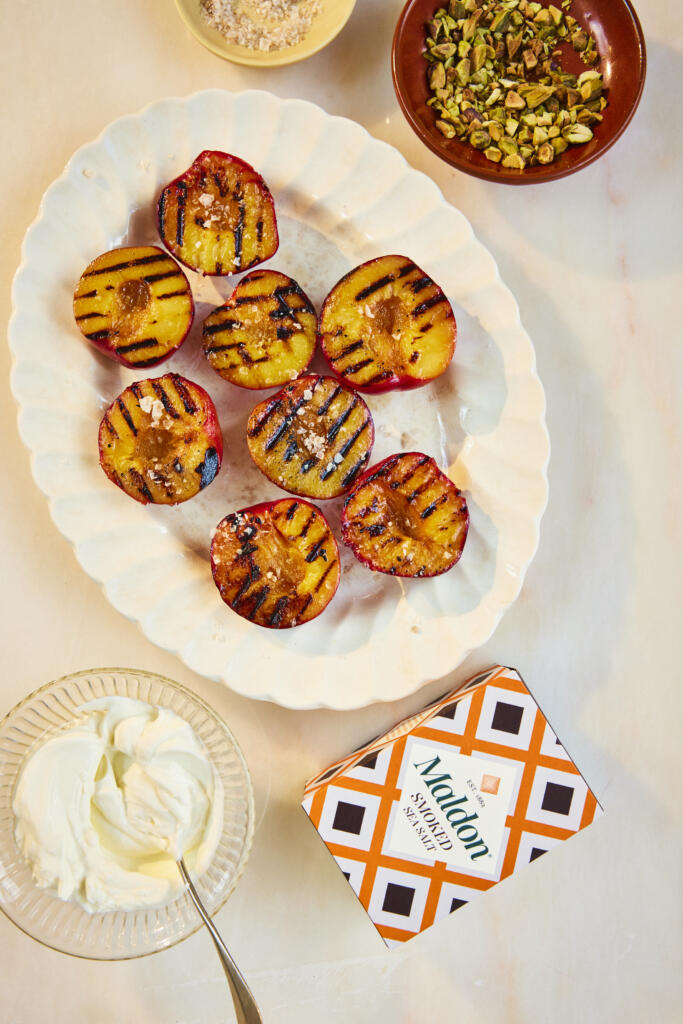
Turn ripe plums into a stunning grilled fruit dessert in minutes. Hot griddle or BBQ heat caramelises the cut sides for deep, smoky‑sweet flavour, while a final sprinkle of Maldon Smoked Sea Salt adds crunchy contrast and subtle smoke. Serve these grilled plums warm with ice cream, yogurt or whipped cream and pistachios for texture — an easy BBQ dessert that feels restaurant‑worthy.
How to Grill Plums?
Heat griddle/BBQ to medium‑high.
Toss halved plums with oil and a pinch of Maldon Smoked Sea Salt.
Grill cut‑side down 2–4 minutes until charred and juicy.
Serve warm with ice cream and pistachios; finish with smoked salt.
How to Make Grilled Plums with Smoked Sea Salt (Detailed Version)
Step 1 – Preheat the Grill/Griddle
Heat a griddle pan over high heat until smoking, or preheat BBQ to medium‑high direct heat (220–260°C / 425–500°F).
Lightly oil the grates if using a BBQ.
Step 2 – Prep the Plums
Toss plum halves with olive oil to coat lightly.
Add a small pinch of Maldon Smoked Sea Salt to enhance sweetness. You should use rip but firm freestone plums so that the halves stay intact.
Step 3 – Grill to Caramelise
Place plums cut‑side down in a single layer.
Cook 2–4 minutes until deeply charred with clear grill marks and juices just begin to bubble. You should see caramelised edges, the texture should be tender but not collapsing.
If desired, flip for 30–60 seconds to warm the skins.
Step 4 – Serve
Plate warm plums. Add ice cream, yogurt or whipped cream.
Sprinkle with pistachios and finish with a pinch more Maldon Smoked Sea Salt.
Optional: drizzle with honey or maple syrup.
Tips & FAQs:
Tips
Don’t overcrowd: space the halves so steam doesn’t soften them.
Oil the fruit, not the pan, to reduce sticking and flare‑ups.
Choose plums that give slightly when pressed; overly soft fruit collapses.
Crosshatch: rotate 90° halfway through for restaurant‑style grill marks.
FAQs
What plums are best for grilling?
Freestone varieties (easier to de‑stone), ripe but firm. Black or red plums both work. This is because their firm flesh holds up well when heated.
How long to grill plums?
Typically 2–4 minutes cut‑side down on a very hot surface; flip briefly to warm through.
Can I make grilled plums on a stovetop?
Yes — use a preheated cast‑iron griddle pan over high heat.
Can I use other stone fruit?
Peaches, nectarines and apricots grill beautifully; timings are similar (smaller fruit needs less time).
How do I prevent sticking?
Preheat thoroughly, brush fruit with oil, and let the sear form before moving.
Lighter: Greek yogurt, honey and fresh thyme leaves.
Indulgent: mascarpone, crushed amaretti and a balsamic reduction drizzle.
Cheese board twist: serve warm plums with burrata or ricotta, olive oil and crusty bread.
Storage & Reheating
Best enjoyed fresh.
Leftovers: refrigerate up to 2 days in an airtight container.
Reheat gently in a skillet over medium heat for 1–2 minutes or serve at room temperature.
Freeze: not recommended (texture turns mushy).
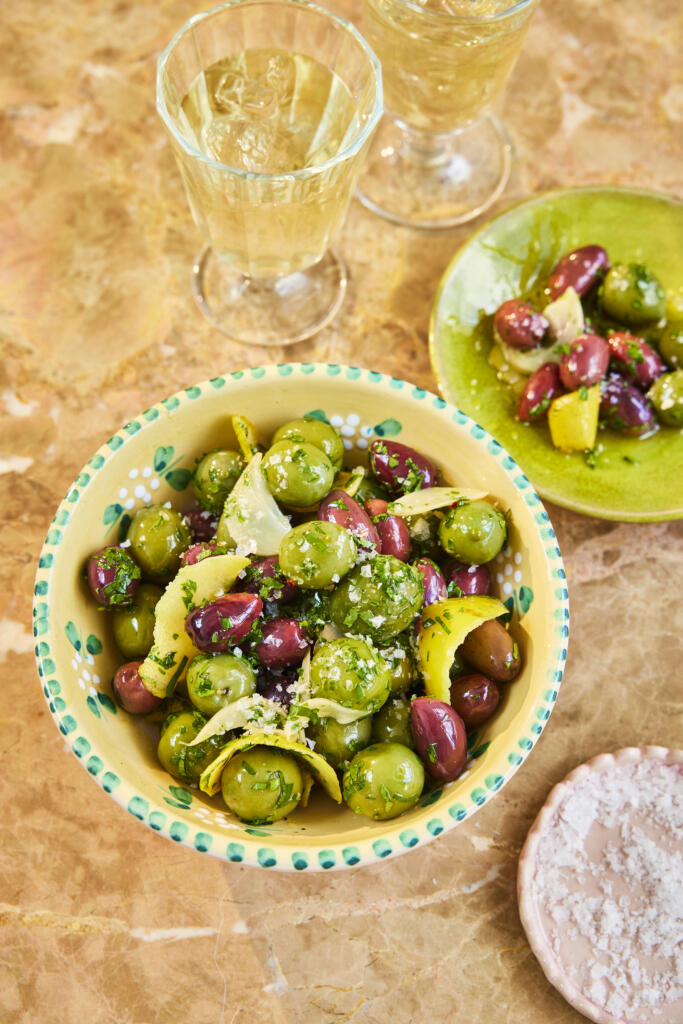
These easy marinated olives take minutes and taste like your favourite tapas bar. Lemon zest, soft garlic and a pinch of chilli infuse warm olive oil, then olives and fresh parsley soak up the flavours. Finished with a pinch of Maldon Original Sea Salt for clean, bright seasoning, this lemon‑garlic olives recipe is ideal for antipasti platters, last‑minute hosting or make‑ahead snacks.
How to Marinate Olives (Quick Steps)
Gently warm olive oil with lemon zest and garlic; add chilli, then cool.
Toss with olives, parsley and a pinch of Maldon Sea Salt.
Marinate 30 minutes to overnight; serve at room temperature.
How to Make Marinated Olives (Detailed Version)
Step 1 – Infuse the Oil
Add olive oil, lemon zest strips and sliced garlic to a small pan.
Warm over medium‑low heat for 3–5 minutes until fragrant and the garlic softens; do not brown. You should see gentle bubbles around the garlic, with the colourisation being pale, not golden.
Step 2 – Add Heat & Cool
Stir in a pinch of chilli flakes.
Immediately remove from the heat and let the oil cool to room temperature.
Step 3 – Toss & Marinate
In a bowl, combine olives, chopped parsley and a pinch of Maldon Original Sea Salt.
Pour over the cooled oil and toss well to coat.
Marinate at least 30 minutes; longer (up to overnight in the fridge) deepens flavour.
Step 4 – Serve
Bring to room temperature. Taste and adjust salt or lemon zest.
Spoon into a serving bowl with some infused oil.
Serving suggestion: finish with a final pinch of Maldon flakes for crunchy contrast.
Tips & FAQs
Tips
Use quality olives. Creamy Castelvetrano or meaty Kalamata work well; mix for colour and texture.
Refrigerate in an airtight container and use within 3–4 days. Keep submerged in oil, and always return leftovers to the fridge. Do not store at room temperature when fresh garlic is used.
Can I reuse the marinade oil?
Use within 3–4 days in salad dressings or to drizzle over feta/roasted veg. Keep refrigerated; discard if in doubt.
Serving Suggestions
Add to antipasti boards with cheeses, cured meats, nuts and crackers.
Spoon over whipped feta or labneh with extra lemon zest and Maldon Sea Salt.